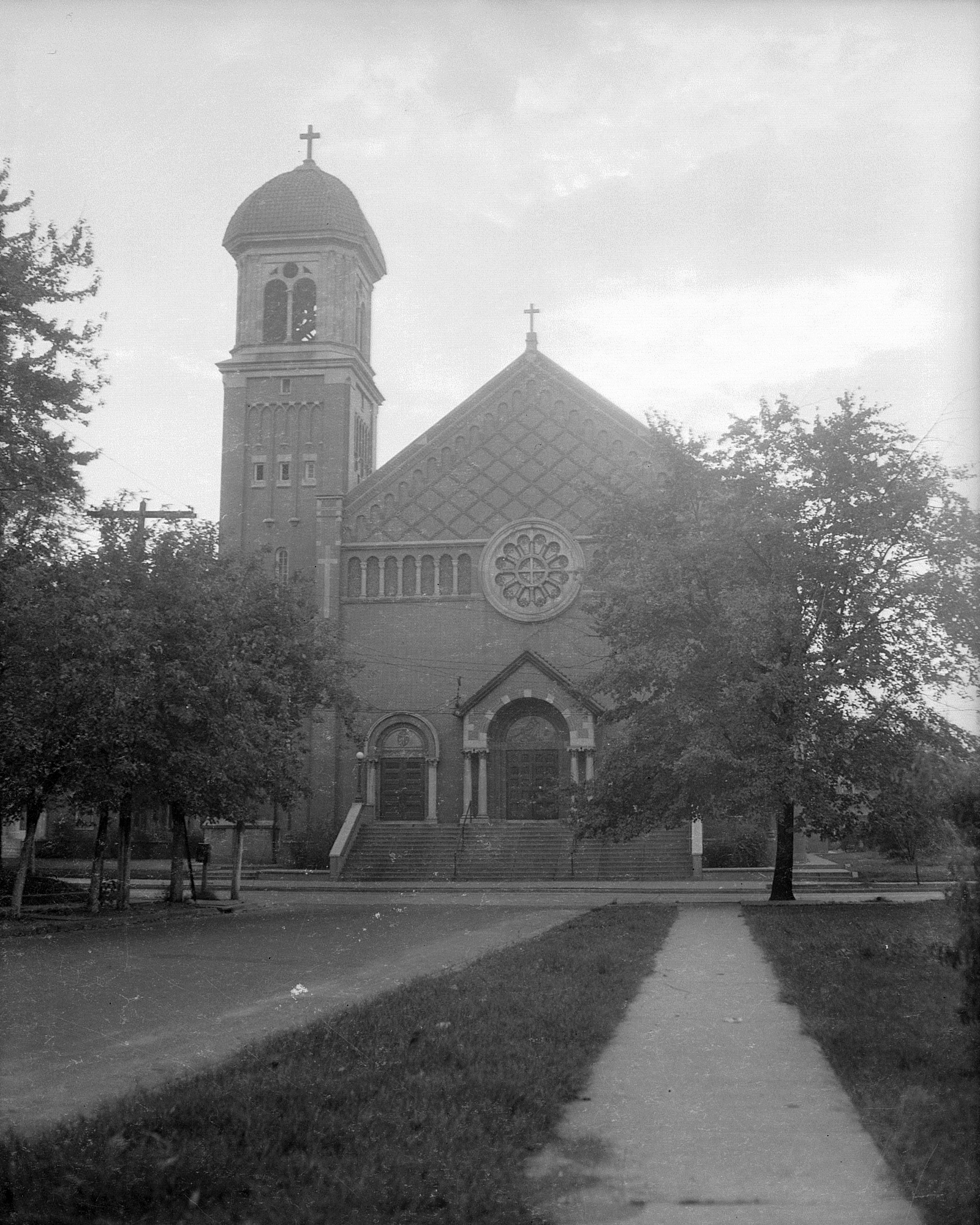
The exterior of St. Stephen Cathedral, the mother church of the Diocese of Owensboro, is seen in 1937, the year the western Kentucky diocese was founded. Just one year prior, the church had been the location for the funeral Mass of Rainey Bethea, the last person to be publicly hanged in the United States. COURTESY OF ST. STEPHEN CATHEDRAL
‘Evil is not overcome by evil’
Reckoning with Owensboro’s past as the site of the last public hanging
BY ELIZABETH WONG BARNSTEAD, THE WESTERN KENTUCKY CATHOLIC
“Buried from Mass at St. Stephen’s.”
These words were written on Aug. 14, 1936, in the daily annals of the Ursuline Sisters of Mount Saint Joseph in Maple Mount, Kentucky, following the public execution of Rainey Bethea in Owensboro.
The records and public recollection of the case are disputed. Historic reports vary on the number of people who gathered to watch the “sensation of Daviess County today,” as recorded in the Mount’s annals, which themselves noted 10,000 people who “witnessed tragedy.”
(A 2011 story by the Associated Press, looking back on the moment in Owensboro’s history, estimated, rather “as many as 20,000 strong.”)
Yet the facts are clear that Bethea, who had been arrested and charged with rape and murder in Owensboro that June, and whose death was the final public hanging in the United States, died a member of the Catholic Church and received a Catholic funeral.
A hand raised for silence
Bethea, a Black man in his 20s, had received the verdict of guilty by the jury after just over four minutes. CapitalPunishmentUK.org, a site that compiles execution cases worldwide, noted that Bethea’s death sentence moved forward despite his case being take up by a team of Black lawyers. The lawyers had argued that the trial was not fair due to racial discrimination.
Bethea was held in the Jefferson County Jail in Louisville – having been transferred there due to authorities’ concern of a mob lynching if he remained in Owensboro – and during that time, he met with Fr. Herman Jerome Lammers.
Fr. Lammers, a young priest of the Archdiocese of Louisville ordained only three years prior and who served as the associate pastor of the Cathedral of the Assumption, accepted Bethea’s request to be baptized and receive Holy Communion.
Bethea entered the Catholic Church and was recorded in the cathedral’s register as “Joseph Rainey Bethea.”
When Bethea was taken to his execution in downtown Owensboro on Aug. 14, Fr. Lammers was by his side. The young priest heard Bethea’s confession and administered Last Rites after the trap door was released.
An Aug. 16, 1936 editorial in Owensboro’s Messenger-Inquirer reported that Fr. Lammers had “held up his hand from the scaffold for silence” and that “the buzz of the multitude’s conversations died down till the fall of the proverbial pin could have been heard.”
The Diocese of Owensboro would only be established the following year, but the future St. Stephen Cathedral already existed as a local parish. According to an Aug. 15, 1936 article in the Messenger-Inquirer, “Requiem mass (sic) was said for Bethea by the Rev. Father Leo J. Denise (sic) at St. Stephen’s Catholic church at 8 a.m. Burial followed shortly afterward.”
(The 23-year-old Fr. Leo J. Dienes – the correct spelling – had himself only been ordained two months prior and was assigned at St. Stephen’s.)
Bethea was buried in a so-called pauper’s grave in Rosehill Elmwood Cemetery in Owensboro, despite his request that his remains be sent to his sister in South Carolina.
There is no record of why this decision was made, nor the exact location of his grave.
Owensboro’s sheriff, Florence Thompson, who had inherited the job after the death of her husband, was herself a Catholic. She had questioned the morality of participating in the execution and had even consulted with local Owensboro priest Fr. Albert J. Thompson.
As the Catholic Church’s teaching in 1936 had not yet deemed capital punishment morally inadmissible, the priest assured her that doing so was not a sin.
Yet, Florence Thompson ultimately hired someone else to spring the trap door and observed the execution from a nearby vehicle.
An Aug. 24, 1936 article in Time magazine quoted Florence Thompson as saying, “I suppose I will spend the rest of my life forgetting – or trying to forget.”
Jesus died for all
Jason Hall, the executive director of the Catholic Conference of Kentucky (the public policy voice of the Catholic Church in Kentucky) grew up in Owensboro, and like most who did, is familiar with the basics of the 1936 case.
Hall only learned recently, however, that Florence Thompson had been Catholic – and was compelled by the apparent “crisis of conscience that the sheriff had.”
“It is not a morally neutral thing – a person is changed” by killing another human being no matter the circumstances, he said.
Hall praised the Church’s development in better understanding the dignity of the human person, which has led the Church to clarify that capital punishment is morally inadmissible.
“(There is a) greater realization of the dignity of the person; that the sanctity of life is not dependent on what they have done,” said Hall.
The teachings of Pope St. John Paul II, especially his encyclical “Evangelium vitae,” spoke of how modern society “has the means of effectively suppressing crime by rendering criminals harmless without definitively denying them the chance to reform.”
In 2018, Pope Francis revised the Catechism of the Catholic Church to clarify the Church’s stance condemning capital punishment “because it is an attack on the inviolability and dignity of the person,” said his note to the bishops.
Most recently, Pope Leo XIV quoted Pope Francis’s message on his official X account on Oct. 10, which is World Day Against the Death Penalty, adding that “The common good can be safeguarded and the requirements of justice can be met without recourse to capital punishment.”
Hall pointed out that “Jesus died for us all,” and that “evil is not overcome because of another death… We don’t make society more just if we add more killing.”
He said he is troubled by the “resurgence in public leaders wanting to resume executions,” such as the U.S. government’s plan to livestream the execution of the 2009 Fort Hood shooter (the livestream was canceled following public outcry).
“Public execution is grounded in the idea of death as a spectacle,” said Hall, but “our criminal justice system shouldn’t be about vengeance and retribution – it should be about restoration… It is a lie that the public is going to benefit from this.”
More steps to take
Bishop William F. Medley, who was born and raised in the Archdiocese of Louisville, also grew up familiar with the story of Rainey Bethea. In fact, as a priest ordained for Louisville, he even knew the late Fr. Lammers.
Bishop Medley said some of the most profound experiences of his episcopacy have been visiting the Kentucky State Penitentiary in Eddyville and celebrating Mass with the inmates on death row. (Currently, there are 23 people on death row in Kentucky.)
“They don’t intermix with the others,” he said, adding that “six or eight would come to Mass.”
At the same time, “I don’t live under an illusion that any of them should be released – most have committed murders and other serious felonies,” he said, but underscored the necessity of respecting the human dignity of all persons.
Many of these individuals have experienced conversions of heart and embraced a Christian life, and some have become Catholic, he said.
“You talk about small Christian communities!” reflected the bishop, explaining that this small crowd of inmates “is their whole world, plus the guards.”
“I’d always opposed the death penalty, but this shaped my perspective,” he said.
Bishop Medley commented that “1936 is a very different time than 2026” in terms of how much of society now opposes or questions the need for the death penalty. (Kentucky abolished public hanging in 1938.)
“I was pleased at the national outcry of that possibility of a publicly livestreamed execution,” he said.
A poll released by Gallup on June 9, 2026, indicated that the percentage of Americans who find capital punishment morally unacceptable has risen to 39%.
As the bishop of Owensboro, which retains the “distinction… that this was the site of the last public hanging,” he said he is “encouraged” at society’s reaction and hopes this could mean a future in which the death penalty is abolished in the United States.
“In 90 years, we have made some progress, but as a nation, we still uphold capital punishment,” he said, adding that in order to more fully embrace respect for human life in the U.S., “there is another step.”
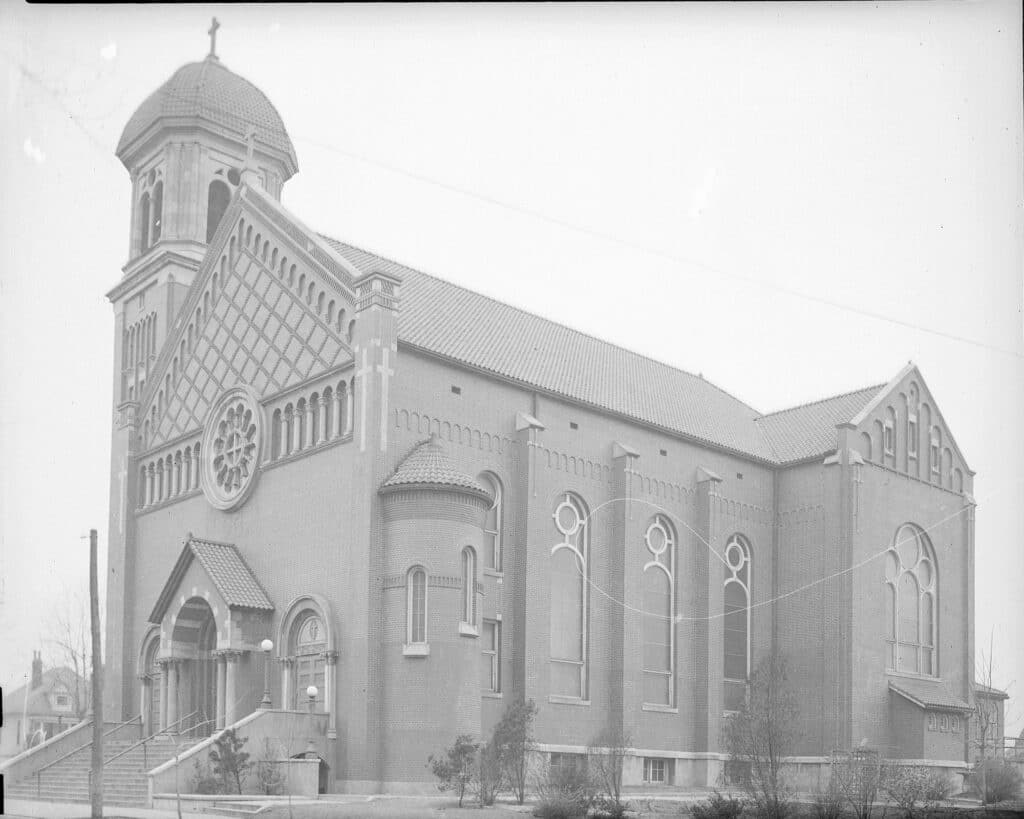
The exterior of St. Stephen Cathedral, the mother church of the Diocese of Owensboro, is seen in 1937, the year the western Kentucky diocese was founded. Just one year prior, the church had been the location for the funeral Mass of Rainey Bethea, the last person to be publicly hanged in the United States. COURTESY OF ST. STEPHEN CATHEDRAL
Originally printed in the November 2026 issue of The Western Kentucky Catholic.