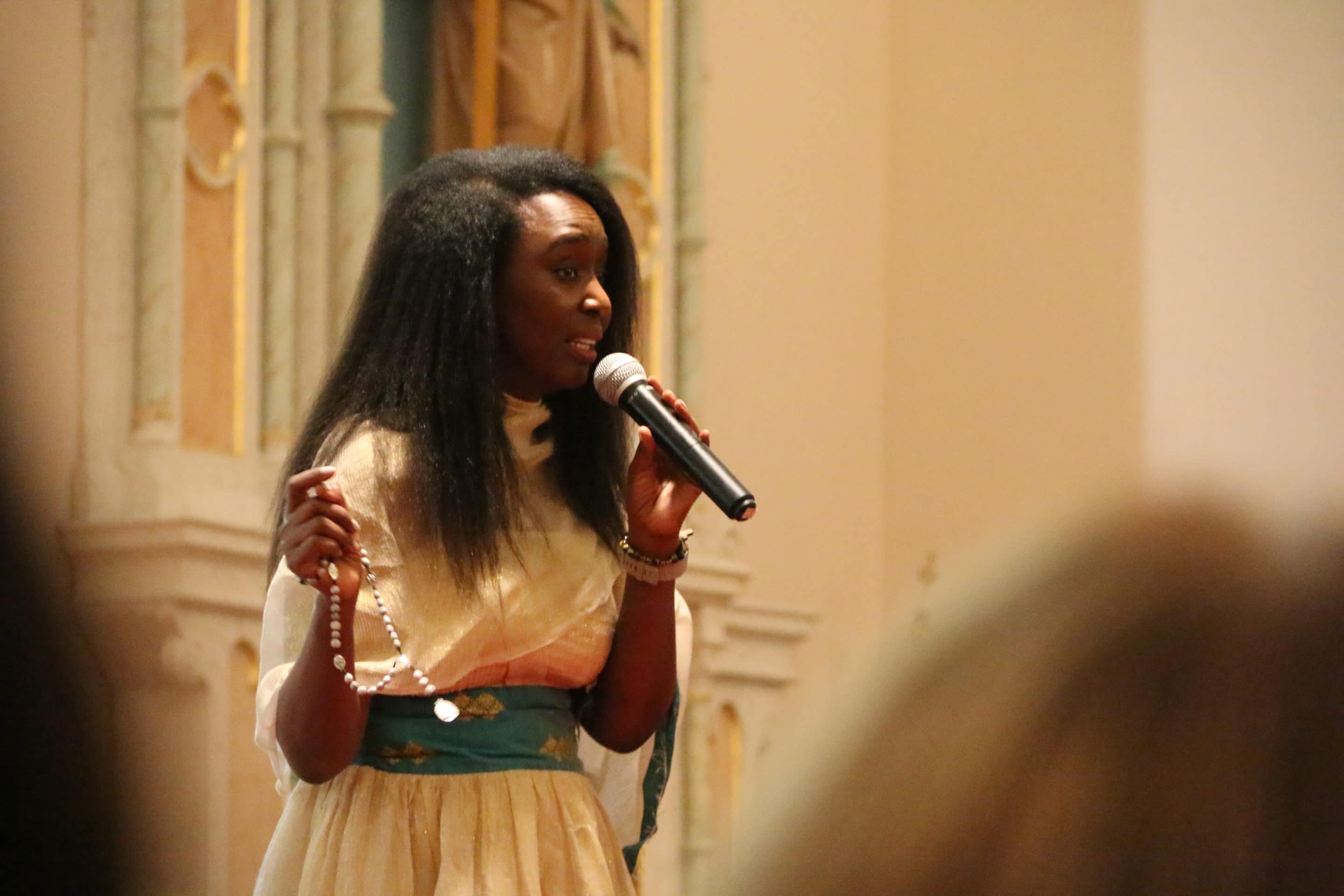
Immaculée Ilibagiza spoke to a crowd St. Agnes Parish on Feb. 15, 2022. Ilibagiza survived the 1994 Rawandan genocide that killed more than one million people, including most of her family. TINA KASEY | WKC
‘Forgiveness is possible in every situation’
Rwandan genocide survivor speaks to crowd at St. Agnes
BY TINA KASEY, THE WESTERN KENTUCKY CATHOLIC
“We don’t know why she’s here (at St. Agnes) but we are grateful,” Lisa Burke told The Western Kentucky Catholic before Immaculée Ilibagiza spoke on Feb. 15, 2022. “It’s the work of the Holy Spirit.”
Burke has seen Ilibagiza through conferences and retreats three times. Three years ago she wrote a note at the conclusion of one of those retreats requesting Ilibagiza come to Uniontown, Ky., and speak at St. Agnes Parish.
“I don’t know if she read the note,” Burke said, “but I knew I wanted to bring her here.”
Immaculée Ilibagiza presented Lisa Burke with a rosary at the conclusion of the event. Burke had invited Ilibagiza to St. Agnes Parish after hearing her speak three other times. TINA KASEY | WKC
Burke, part of a small prayer group at the parish that has been meeting for the past six years, told the group she’d love to bring Ilibagiza for everyone to hear her incredible story of hope, faith and forgiveness after surviving the 1994 Rwandan genocide in Africa. The group encouraged her to invite Ilibagiza and so she wrote a letter to Ilibagiza’s booking manager. He responded with a date: Feb. 15.
“It never occurred to me that it wouldn’t happen,” Burke said.
Burke said she feels drawn to Ilibagiza because “she prays from her heart. I think I’ve learned how to pray from her.”
Ilibagiza and seven other females (ages 7 to 51) survived for 91 days hidden inside a three by four foot bathroom, while one million men, women and children (mostly Tutsis) were wiped out in a horrendous planned attack in her country of Rwanda.
There were two main tribes or ethnic groups in Rwanda: Hutu and Tutsi. Rwandans were split into these groups based on their “height and shape of their nose,” Ilibagiza explained to the standing room-only group inside St. Agnes, holding a rosary in one hand.
“Sometimes families were split-up with brothers in different tribes.”
Ilibagiza, a college student and daughter of teachers in their local village, was home for Easter break when the news broke that the president of Rwanda was murdered.
Her father, realizing what was coming, told her family to pray and then found a place to send Ilibagiza.
“We were Tutsi…my father wanted to keep me safe so he sent me to a friend’s house, who was Hutu, to hide,” Ilibagiza told the crowd. “We couldn’t speak, we couldn’t flush toilets, and we had to sleep on top of each other,” she said.
She said she spent a lot of time asking why. She went from anger to fear to not caring whether she lived or died.
However, it was the rosary her father gave her before she hid that brought Ilibagiza immense peace. She began to pray it a hundred times a day. Those prayers, especially the Lord’s Prayer, planted the seeds of forgiveness in Ilibagiza.
“Every time I got to the part asking God to ‘forgive those who trespass against us,’ I couldn’t say it,” she said. Eventually though, Ilibagiza realized that if she could believe God for the rest of the prayer, she needed to be able to pray the entire prayer and forgive, even those who were killing family, friends and neighbors.
After 91 days, when Ilibagiza was able to leave that bathroom, she had lost half of her body weight and found that her entire family, save one brother studying abroad, had been brutally murdered.
“I screamed and cried for five minutes,” she said, emotion showing on her face. “I realized that God is my Father. My only father now.”
Ilibagiza called her experience in that tiny bathroom as “life-changing.” Those months of prayer prepared her to be able to forgive those who killed her family, she said.
“I learned through this experience that with God, all things are possible.” Even forgiveness.
“I want to tell you this, forgive everyone. Forgiveness is possible in every situation,” Ilibagiza said.
At the conclusion of Ilibagiza’s talk, she presented Burke with the rosary she had held onto all night.
“Her courage is amazing,” Burke commented. “It makes me want to be courageous.”
Originally printed in the March 2022 issue of The Western Kentucky Catholic.