
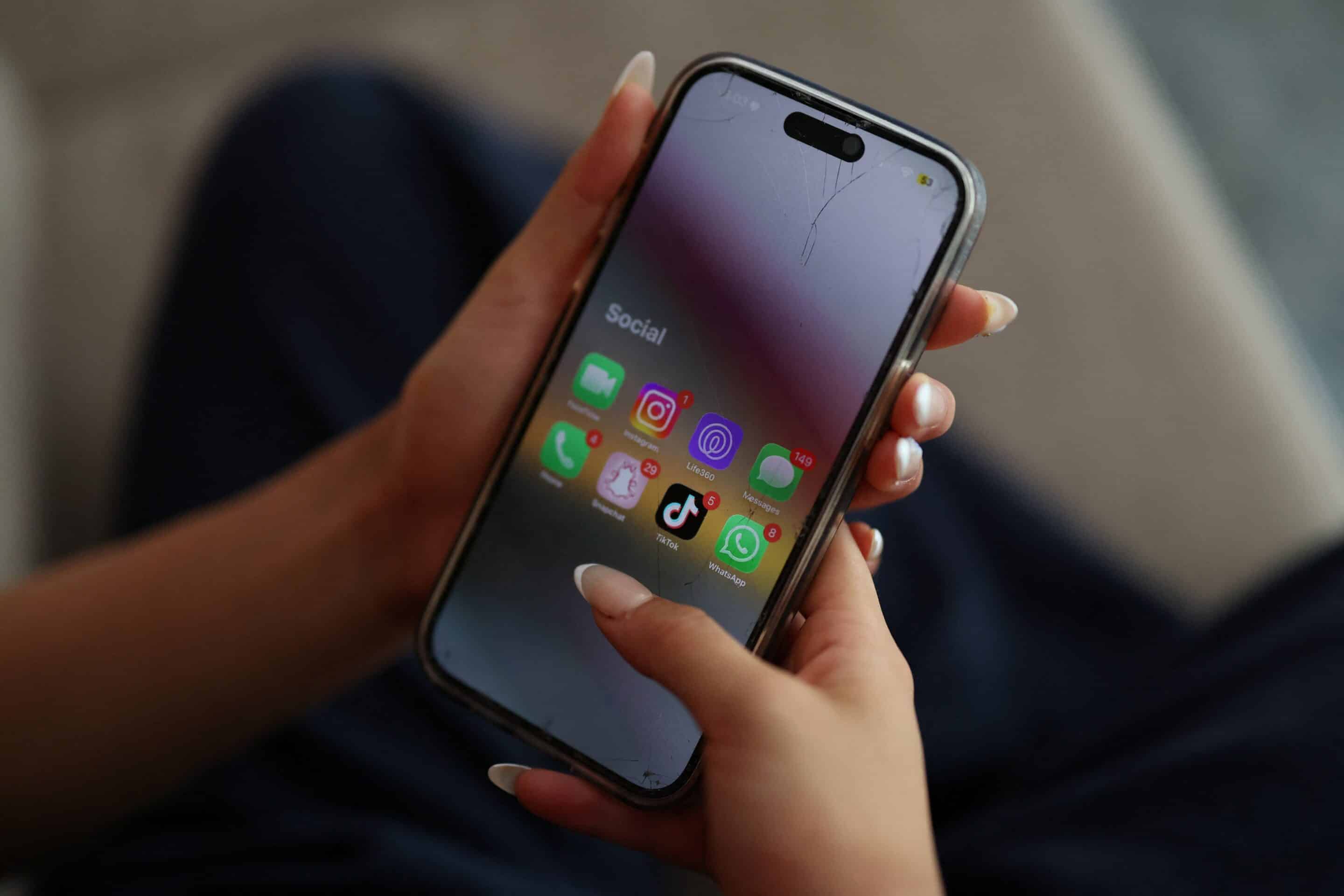
A 14-year-old displays her cellphone in Sydney Dec. 10, 2025, as a law banning social media for users under 16 in Australia takes effect. OSV NEWS PHOTO/HOLLIE ADAMS, REUTERS
What do parents need to know about cellphone usage and is there anything we should be doing differently?
BY CHARLIE HARDESTY, OFFICE OF YOUTH AND YOUNG ADULT MINISTRY
I am jumping right in feet first into one of the more common conversations that parents wanted to have as we gathered in the initial in-person “Building a Family of Faith” sessions. And before I get too far into this answer, I want to make sure to highlight that this question is deeply layered, challenging, and unique to the individual young people and their technology habits. I do, however, believe there are some useful strategies to help cellphone use be as healthy an experience as possible.
Quite a bit of research is being done right now on cellphone use and adolescents and not all the data coming out is as predictable as one might assume. It is not automatic that cellphones and social media use cause young people to be more anxious or depressed. It is also not necessarily proven that removing this technology from your young person will increase their mental health. There are just so many factors at play, and so it is essential for parents to stay involved and informed before setting their children free with a handheld computer more powerful than the desktop computer I started college with.
Our number one suggestion is to help young people see access to a cellphone as using a tool; much like the home phone from my teenage years was a tool. I knew this tool was not mine. I knew this tool really was not private and that at any moment my parents might pick up on the other line in the house to listen in or tell me to go to bed. For this reason, I wonder what would happen if we stopped giving young people phones at major milestones like birthdays or Christmas. It seems confusing for a gift not to be personally owned, so perhaps introduce a cellphone at a time when the utility of it makes more sense than the desire for it.
Another suggestion we have is for all cellphones, including your own, to be charged somewhere other than in bedrooms. If strong research on this topic exists anywhere, it is in the idea that cellphones are drastically impacting quality sleep. We hear story after story of young people exhausted at school from “doom scrolling” all night or answering texts. We suggest a charging spot in a public place in your home for all phones and we suggest you model this behavior as parents for your own phone challenges.
Lastly, for now, we suggest you be deeply engaged in monitoring cellphone use with your children. Again, if it is a tool, then this is not an invasion of privacy, and besides, I do not recall my parents being too deeply concerned with my privacy! (As a parent myself today, I see that now as an expression of care and love.)
I do find it concerning how quickly cellphones seem to induce lying for many teens. Your young people are smart and will quickly learn how to clear browsing histories and hide things. The more you can stay engaged, the harder it becomes for young people to wander into unhealthy spaces and create unhealthy habits.
I am confident we will spend more time looking at technology in the future, but for now, tell us what you think at familylife@pastoral.org. For more parent-to-parent conversation like this, along with faith-sharing tips and plenty of laughs, check out “Building a Family of Faith” podcast hosted by Rachel Hall, Charlie Hardesty, Susy Solorza, and Danny May. Available now wherever you get your podcasts.
The “Building a Family of Faith” column is a collaborative effort among the Offices of Youth & Young Adult Ministry, Marriage & Family Life, and Communications. Access more resources at owensborodiocese.org/building-a-family-of-faith.
Originally printed in the November 2026 issue of The Western Kentucky Catholic.