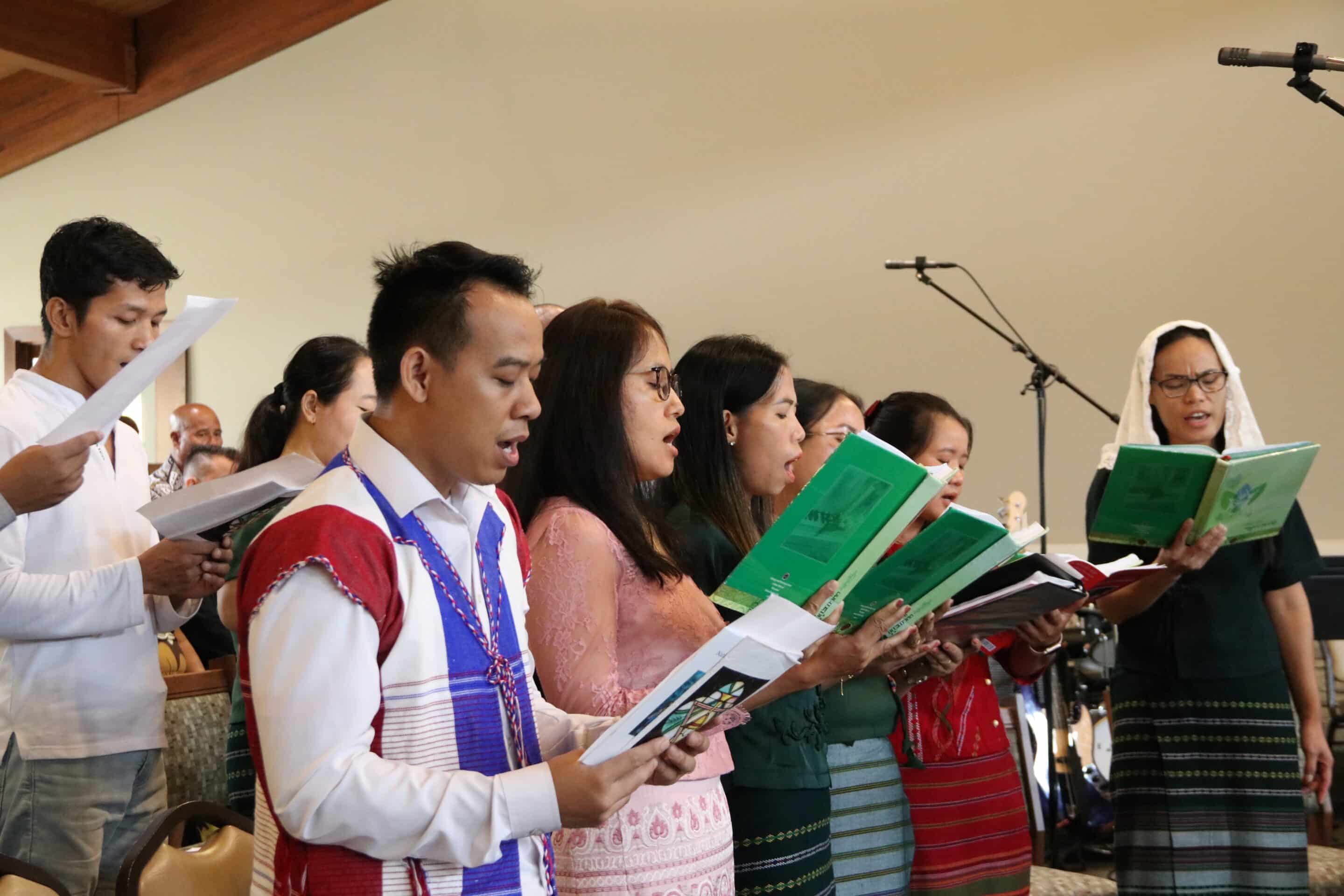
Members of the choir sing during the Oct. 3, 2026 diocesan Migration Mass at Holy Spirit Parish in Bowling Green. RILEY GREIF | WKC
The sacred gift of co-responsibility: Living the mission of Christ together
BY DR. JEFF ANDRINI, EVANGELIZATION & DISCIPLESHIP
For centuries, a persistent misconception shaped the practical life of the Catholic Church: the idea that the clergy held sole responsibility for the Church’s mission, while the laity were mere passive recipients of spiritual care. The Second Vatican Council fundamentally challenged this dynamic, calling the Church to rediscover its identity as the unified people of God. At the core of this modern ecclesial renewal lies the concept of co-responsibility – the conviction that all the baptized, ordained and lay alike, share a common responsibility for carrying out the mission of Jesus Christ in the world.
The theological foundation for co-responsibility rests firmly on the sacrament of baptism. Through baptism, every Christian is incorporated into Christ, configured to His life, and given a real share in His triple office as priest, prophet, and king. Baptism is not merely a private purification or an initiation into an organization; it is an active commissioning into the divine life and salvific mission of the Church. As the Council stresses in Lumen Gentium (The Dogmatic Constitution on the Church), the faithful are called as living members to dedicate their energy to the continuous growth and sanctification of Christ’s Body.
A central emphasis of Vatican II is the universal call to holiness. Chapter V of Lumen Gentium explicitly teaches that holiness is not the exclusive domain of priests, bishops, or religious communities. Rather, every Christian, regardless of state in life, occupation, or circumstance, is called to the fullness of Christian life and the perfection of charity. Because holiness and mission are intrinsically linked, the obligation to proclaim the Gospel and transform society belongs to every single believer.
Co-responsibility requires a profound shift in mindset regarding how clergy and laity relate to one another. As Pope Benedict XVI observed, the lay faithful must not be treated merely as “collaborators” who assist the clergy in their tasks but rather recognized as people who are truly “co-responsible” for the Church’s being and action. While the ordained clergy exercise an essential, distinct ministry of word, sacrament, and shepherdly oversight, their authority exists to equip, serve, and empower the whole Body of Christ. The laity, in turn, possess a unique vocation to sanctify the secular world: bringing the light of the Gospel into family life, politics, economics, science, and culture, where the ordained cannot easily reach.
In contemporary Church life, this vision of co-responsibility finds its fullest expression through synodality. Synodality – literally meaning “walking together” – is the structural and spiritual process by which the Church practices mutual listening, discernment, and shared responsibility across all levels of ecclesial life. By cultivating spaces where the voices of the laity, religious, and clergy are heard in dynamic dialogue, synodality ensures that the gifts bestowed on every baptized believer by the Holy Spirit are woven together to serve the one mission of Christ.
Co-responsibility is a profound expression of ecclesial communion, where ordained ministers and laypersons embrace their shared baptismal dignity and serve the mission of Jesus.
Dr. Jeff Andrini is the director of the Office of Evangelization and Discipleship. Contact him at jeff.andrini@pastoral.org.
Originally printed in the November 2026 issue of The Western Kentucky Catholic.