
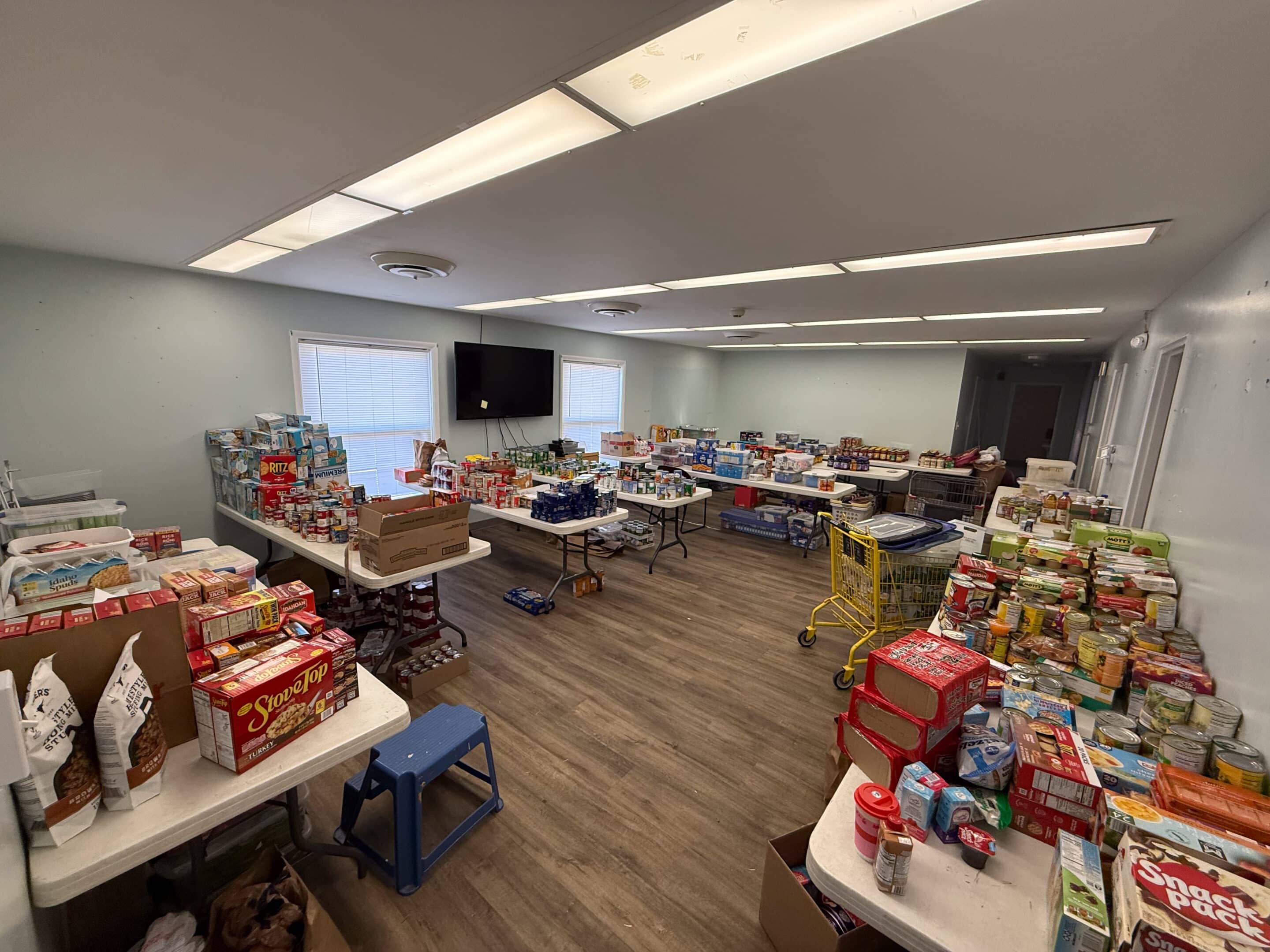
The food pantry at Our Lady of Lourdes Parish in Owensboro is seen in fall 2025. Volunteers say Lourdes has seen an uptick in essential needs since the federal government shut down, and even after it reopened, the local community is still struggling to catch up. COURTESY OF KIM MORGAN
Rising needs met with rising compassion: Diocese-wide response to help fellow Kentuckians
BY RACHEL HALL, THE WESTERN KENTUCKY CATHOLIC
“This is the heartbeat of America,” said Harry Pedigo, the executive director of St. Benedict’s Homeless Shelter and the Pitino Shelter in Owensboro, reflecting on the nation’s resilience during hardship, “when things get tough, we pull together.”
Recent weeks have shown that clearly. The Oct. 1-Nov. 12 federal government shutdown lasted 43 days, delaying crucial food assistance programs such as the USDA’s Supplemental Nutrition Assistance Program (SNAP) and the Special Supplemental Nutrition Program for Women, Infants, and Children (WIC). These benefits support roughly one in eight Kentuckians – many of them elderly, children, or working families struggling to make ends meet.
Across the Diocese of Owensboro, Catholic parishes and ministries have stepped forward to help. The Church has long committed to serving those in need, following the Gospel’s call to see Christ in those who suffer and are forgotten.
At the Pitino Shelter, which along with St. Benedict’s operates under the umbrella of Catholic Charities, Pedigo described an increasingly common scene: a nicely dressed person walks into the office and softly asks to see the director.
“They are out of their comfort zone,” he said. “They ask where to go for food boxes. You can tell they haven’t done this before.”
The shelter’s soup kitchen has also seen a rise in need, jumping from 100 people a day to 150. In addition to their own increases, they have also stepped up in donating to other nonprofits in the area where they supply basic essentials which people can take with them.
Concerns about potential budget cuts continue, as people are required to reapply for benefits as part of the USDA’s effort to reduce fraud.
Kim Morgan who oversees the food pantry at Our Lady of Lourdes Parish in Owensboro said, “We are trying to not turn anyone away.”
Now operating in two-hour shifts, the pantry uses four volunteers at a time.
“In the first week of November we served 38 families in just six hours,” Morgan said, which is a dramatic increase. She believed much of the increase came after the parish was added to the Facebook group “Feeding Owensboro.”
Anticipating that benefits might not be dispersed at the beginning of November, Lourdes had asked parishioners after each Mass to fill a brown paper bag and return them. The response was overwhelming and soon donations overflowed into the parish hall. Soon parishioners from Immaculate and Blessed Mother were bringing in donations too.
“The word was out,” Morgan said.
Morgan reflected on the relationships formed, on getting to know people and their situations, including parishioners who were quietly seeking help, she added, “It humbles you.”
Beyond pantry staples, people can also seek financial assistance through their parish’s St. Vincent de Paul Society. Many of the ministries at Lourdes lean into the corporal works of mercy, and through a social concerns committee they communicate and work together.
An example is during Lent when the Knights of Columbus delivered over 25 hot fish fry plates to the homebound. Another example is their backpack program that helps local schoolchildren ensure they have food at home for the weekend.
“We want them to feel seen,” Morgan said, noting an upcoming chili supper donated by The Dipper, that will be provided for those families at the parish hall: “We are here for you, and we love you.”
In Paducah, Diane Stoverink volunteers with the St. Vincent de Paul Society of McCracken County. They “typically see 60 to 70 families a week,” but in recent weeks had an additional 10-20 more families seeking help,” she said.
Their St. Vincent de Paul includes a thrift store, financial assistance program, and a food pantry, all supported by many of the surrounding churches and community partners. One major supporter is Christmas in the Park, organized by Paducah Power Systems, which draws thousands of visitors each year.
In Hancock Couty, Robert Durbin, president of the local St. Vincent de Paul, said simply, “they stay busy year-round.” Working with the schools, they help schoolchildren who qualify for assistance receive a free pair of new shoes twice a year, sometimes up to 300 pairs at once.
At a local assisted living facility, St. Vincent de Paul regularly supplies furniture and essentials for residents, who “a lot of times, they come in with the clothes on their backs,” said Durbin.
In partnership with local factories, funds and other donations to the thrift shop help them, and in turn buy coats for those in need.
“Funds just go back into the community,” Durbin said.
Back in Owensboro, Pedigo shared that “panic has gone done” since the government reopened, but people are still trying to catch up.
“It can all be gone in an instant,” he said. “I challenge people to change their perspectives on things.”
Amid the rising needs, there was also a surge of generosity: “Everyone was pulling for each other,” he said, “sending what they had where it needed to go.”
He said in total there were 30 different groups in the area all working together.
Across the diocese, the theme emerged of a shared effort. As Durbin put it:
“We will always walk with the poor.”
Originally printed in the December 2025 issue of The Western Kentucky Catholic.