
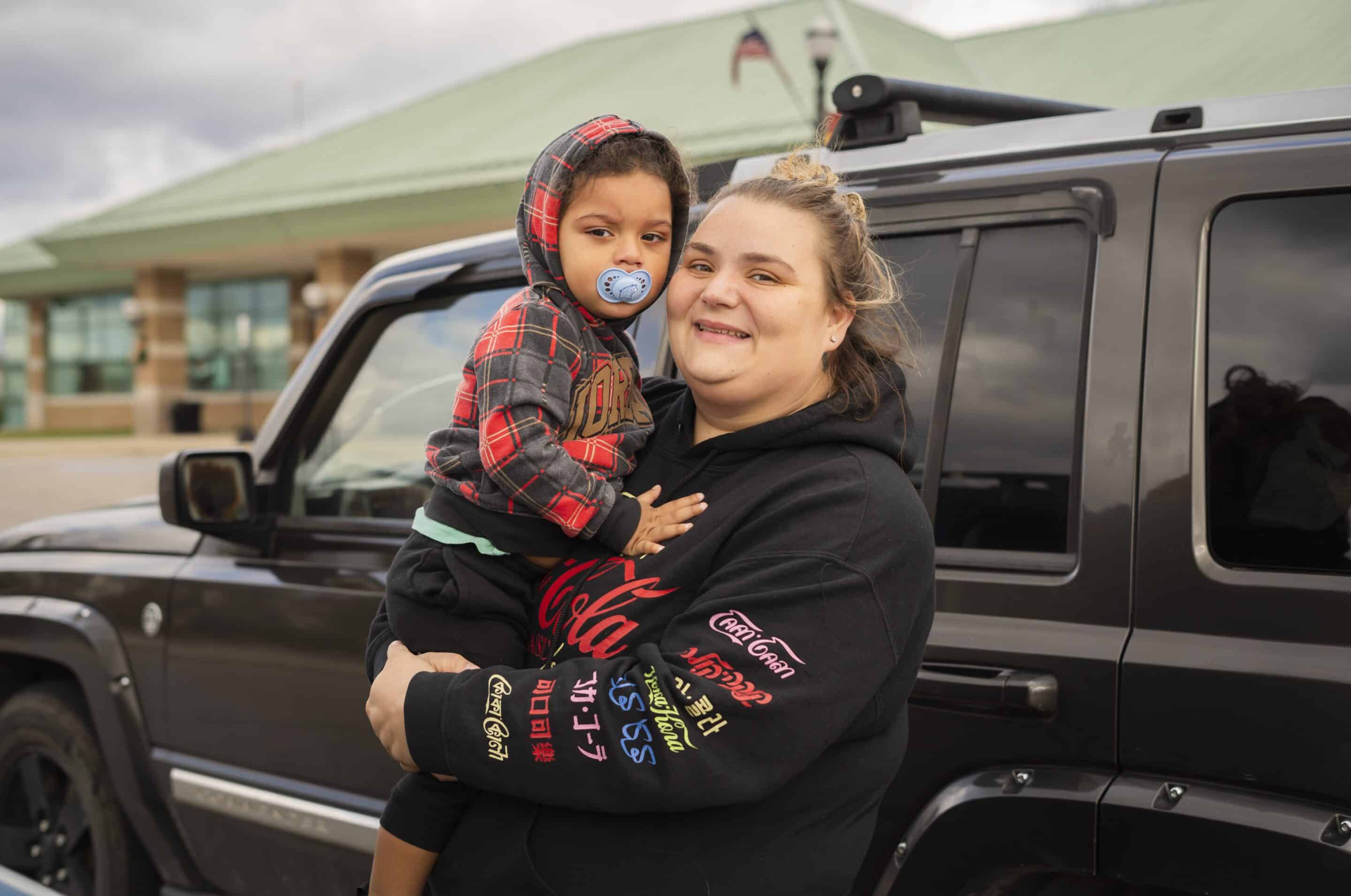
Shelly Pozos Lule poses with one of her now-2-year-old twins, outside Holy Family Catholic Church in Novi, Mich., where she found friendship and support in Roxanne Hundsrucker, the parish’s Christian service director. Pozos Lule faced a crossroads after her husband left her and she suddenly became a single parent to four kids and was pregnant with twins. Holy Family is one of many parishes in the Detroit archdiocese participating in the U.S. bishops’ Walking with Moms in Need initiative. OSV NEWS PHOTO/VALAURIAN WALLER, DETROIT CATHOLIC
Protecting the vulnerable second victims of abortion
BY JASON D. HALL, CATHOLIC CONFERENCE OF KENTUCKY
The overturning of Roe v. Wade in 2022 has brought our country and the pro-life movement to a new political and legal reality. The achievement of that longstanding goal requires us all to consider anew how to best protect unborn life and support families in difficult circumstances.
The Catholic Church has built on our longstanding work supporting vulnerable women and families with initiatives like “Walking with Moms in Need,” a parish-based program geared toward meeting the needs of women and families in local communities. The program “works to ensure that any woman who finds herself unexpectedly pregnant, or parenting in difficult circumstances, can turn to her local Catholic Church and be connected with the resources she needs. Volunteers walk with moms throughout the motherhood journey, offering them authentic Christian friendship and ongoing support.” (walkingwithmoms.com)
Many parishes throughout Kentucky are participating in this program and adapting it to their local realities. I believe this is an effort, and an approach, of which we should all be proud. To build a culture of life means loving and supporting people in their real-life circumstances, whatever those may be, and ensuring they have the means to make life-affirming choices.
Others in the pro-life movement have chosen a different approach. A movement favoring so-called “Abortion Abolition” wants to criminally prosecute women who seek abortions. If “abortion is murder,” the argument goes, then anyone procuring an abortion should be prosecuted.
It is certainly true that abortion is the taking of an innocent human life and the Church, including Pope St. John Paul II and Pope Francis, have used the word “murder” to describe it. And, the Catechism does anticipate “penal sanctions” being appropriate in some circumstances.
However, colloquially speaking of murder to highlight the moral gravity of what is happening in an abortion is quite different from the legal definition of murder.
The crime of murder (indeed, all intentional homicides) requires a mental state (premeditation or “malice aforethought”) that is simply not present in the vast majority of women seeking abortion. Women seeking abortions are almost always facing pressures arising from a relationship, financial concerns, or other fears.
As Pope Francis wrote, “unborn children [are] the most defenceless and innocent among us…this defence of unborn life is closely linked to the defence of each and every other human right.…On the other hand, it is also true that we have done little to adequately accompany women in very difficult situations, where abortion appears as a quick solution to their profound anguish, especially when the life developing within them is the result of rape or a situation of extreme poverty. Who can remain unmoved before such painful situations?”
The mind of the Church, and indeed most of the pro-life movement, has long been that women are a second victim of abortion. Penal sanctions might indeed be appropriate in certain circumstances, for a provider or other involved person, but not the woman. Again, to impose punishment on the woman is to victimize her a second time.
Jason D. Hall, a native of Owensboro, Ky., serves as the executive director of Catholic Conference of Kentucky, which represents the Church and the state’s four Roman Catholic dioceses in public policy matters on both the state and federal level. Learn more at ccky.org.