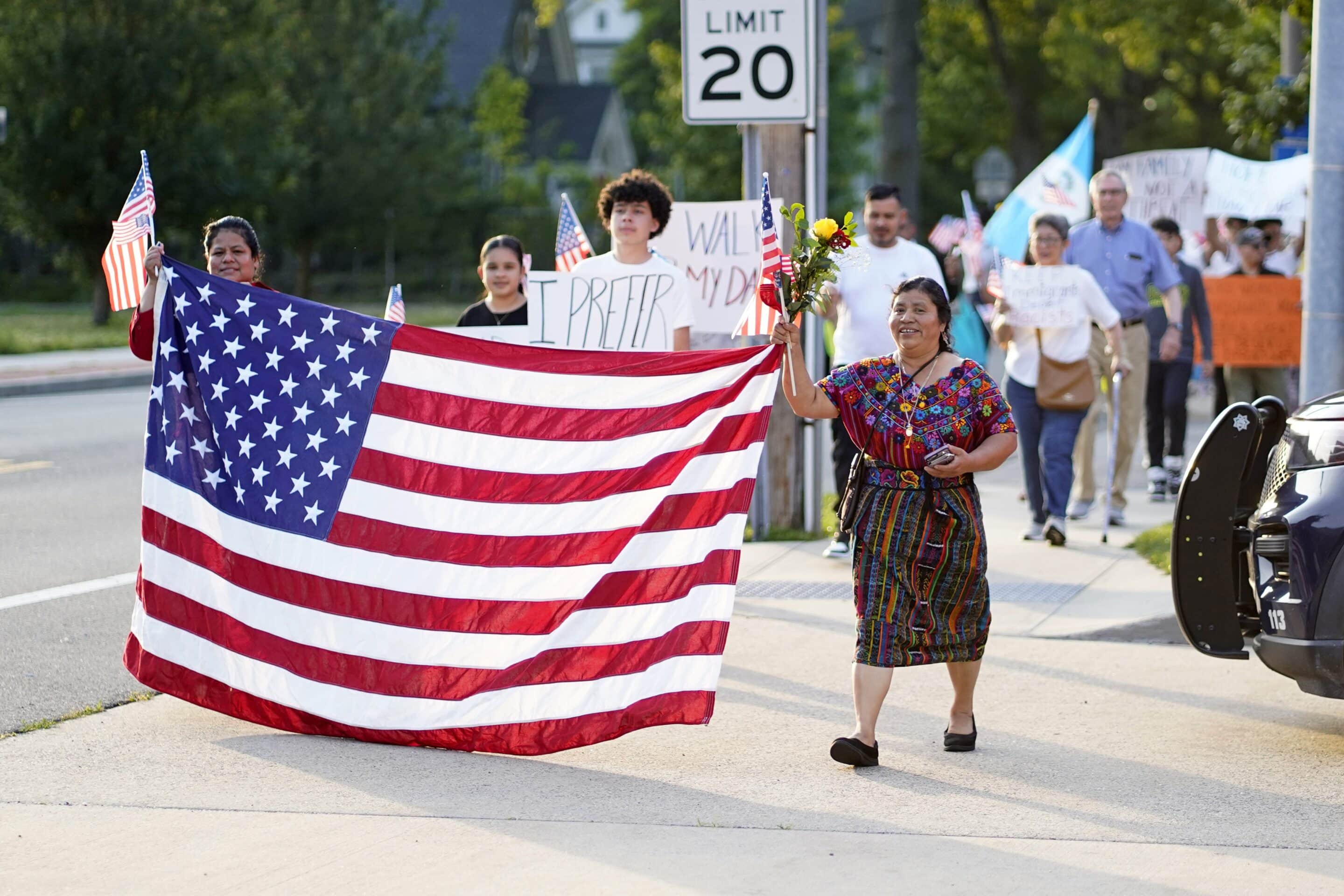
Women hold a U.S. flag as they lead a pro-immigrant march following a Spanish-language Mass at St. John the Evangelist Church in Riverhead, N.Y., June 22, 2025, the feast of the Body and Blood of Christ. St. John’s parish social ministry organized the event, which drew about 300 participants. OSV NEWS PHOTO/GREGORY A. SHEMITZ
Called to love: A Catholic invitation to dialogue on immigration
BY DCN. JAY W. VANHOOSIER, OFFICE OF FAITH FORMATION
In today’s polarized world, few topics stir more passionate debate than immigration. The United States faces complex challenges at the border, in our laws, and in our communities. Emotions run high: fear, frustration, compassion, and concern are all part of the conversation. As Catholics, we are not called to avoid these difficult issues. Rather, we are called to approach them in a spirit of charity, truth, and mercy, grounded in the teachings of Jesus Christ.
The temptation to speak in absolutes or to vilify one another over political views is strong. But the Gospel offers us a better way. It calls us to see each person – regardless of legal status, nationality, or background – as a beloved child of God. We are reminded in Matthew 25:35, “I was a stranger and you welcomed me.” Christ does not qualify His command by political affiliation or economic analysis. He simply commands us to love.
This does not mean ignoring laws or failing to address real problems in our immigration system. As citizens, we have the right and the responsibility to seek just and reasonable solutions. But as followers of Jesus, our discourse must reflect His heart. We must avoid language that dehumanizes. We must refuse to see migrants as threats before seeing them as people. And we must speak with humility, always aware that we may not fully understand another person’s journey.
The Catechism of the Catholic Church teaches that “the more prosperous nations are obliged, to the extent they are able, to welcome the foreigner in search of the security and the means of livelihood which he cannot find in his country of origin” (CCC 2241). This does not dismiss the role of law or order, but it places compassion at the center of our discernment. Love and prudence are not enemies – they are partners when guided by faith.
It is also worth remembering that the Catholic Church in the United States is itself shaped by immigration. Our parishes, schools, and communities were built by immigrants who came seeking freedom, safety, and opportunity. Many of us are descendants of those who were once viewed as “outsiders.” Today, new faces bring new gifts, and we are richer for it.
In this moment, the Church must be a bridge, not a battleground. We are called to model loving dialogue, where people of differing views can speak honestly without fear, and listen deeply without judgment. This means we must listen to the voices of migrants, border communities, law enforcement, and policymakers – always with the Gospel as our guide.
Let us move forward with courage and compassion. May we speak the truth in love, and act with justice shaped by mercy. And may our witness as Catholics always reflect the One who welcomed the stranger, defended the poor, and broke down the barriers that divide.
Dcn. Jay W. VanHoosier is the Director of Faith Formation for the Diocese of Owensboro. For more information visit owensborodiocese.org/faith-formation, email jay.vanhoosier@pastoral.org or call (270) 852-8324.
Originally printed in the August 2025 issue of The Western Kentucky Catholic.