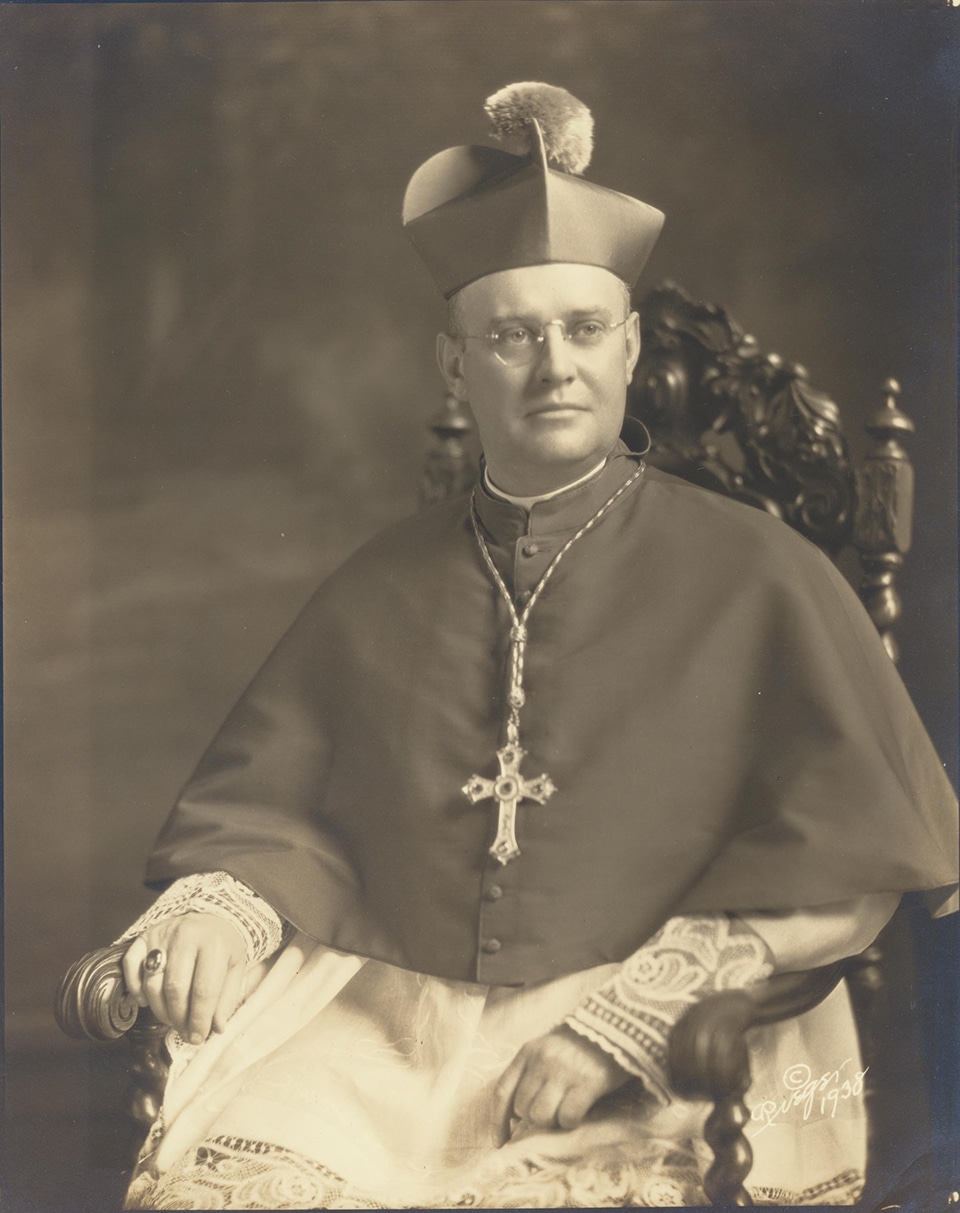
Seen is Bishop Francis R. Cotton, the first bishop of the Diocese of Owensboro, in this undated photo. Bishop Cotton encountered one of his first struggles as a bishop as he assigned priests in the newly-formed Diocese of Owensboro. COURTESY OF ARCHIVES
The 40 Martyrs: Fr. Robert Gipperich (Part 1)
BY EDWARD WILSON, ARCHIVES
The 40 Martyrs is the moniker given to the first priests of our diocese. They were given this title because they were displaced from their home, the Diocese of Louisville. Without warning, they were bound to a newly created rural diocese. Though many of these priests doubtlessly felt it a great honor to become the first to serve in the newly created spiritual frontier, there were others that felt as if they had been torn from the arms of their mother. This is the story of one such priest.
On Dec. 9, 1937, the creation of the Diocese of Owensboro was announced. One week later, on Dec. 16, it was declared that Fr. Francis R. Cotton, the highly respected chancellor of the Diocese of Louisville, would be installed as its first bishop. That same day, Fr. Robert Gipperich sat down and penned a congratulation to his friend and brother priest. The letter began, “Most Rev dear Bishop Elect: Heartiest congratulations on your appointment to the Bishopric of Owensboro.” Following this cordial congratulation, Fr. Gipperich asked one simple thing of his old friend: he requested to be released from the Diocese of Owensboro and allowed to return to his service in the now Archdiocese of Louisville.
Fr. Gipperich seemed to think it was a simple enough request. Not only were he and the newly-announced bishop friends, but before accepting the assignment in Owensboro, he had also received the word of the archbishop that he would be returned to Louisville in a reasonable amount of time. However, to all their surprise, within a few short years of Fr. Gipperich’s assignment to the western portion of the Louisville diocese, the Diocese of Owensboro was created. Fr. Gipperich also sent a copy of the letter to the archbishop, boldly reminding him of his promise. The priest was in for a rude awakening and Bishop Cotton was about to encounter one of his first struggles as bishop.
Bishop Cotton only had two options: let the priest return or have him stay. Sadly, neither of these seemed to present a promising result. If he told Fr. Gipperich that he could not leave, he would be separating a priest from his family, who resided in Louisville, and forcing him to stay in a place that he very specifically said would negatively affect himself and his vocation. However, letting him leave would set a precedent and possibly open a floodgate of priests who also wished to return to Louisville.
How the bishop-elect chose to handle this situation would set the tone for his leadership of the new diocese.
This article is the first of a three-part series. This situation continued to play out for over 20 years. Though the 40 martyrs and their ordeal are mentioned occasionally when speaking of our history, the true weight of their sacrifice cannot be fully appreciated without their very own words giving life to their struggle. Hopefully, this small series will serve to illuminate some of the silent sacrifices made by our priests from the very foundation of our diocese.
Edward Wilson is the director of the Diocese of Owensboro’s Archives and the Archives of the Ursuline Sisters of Mount Saint Joseph. Comments and questions may be sent to edward.wilson@pastoral.org.
Related:
Originally printed in the August 2025 issue of The Western Kentucky Catholic.