
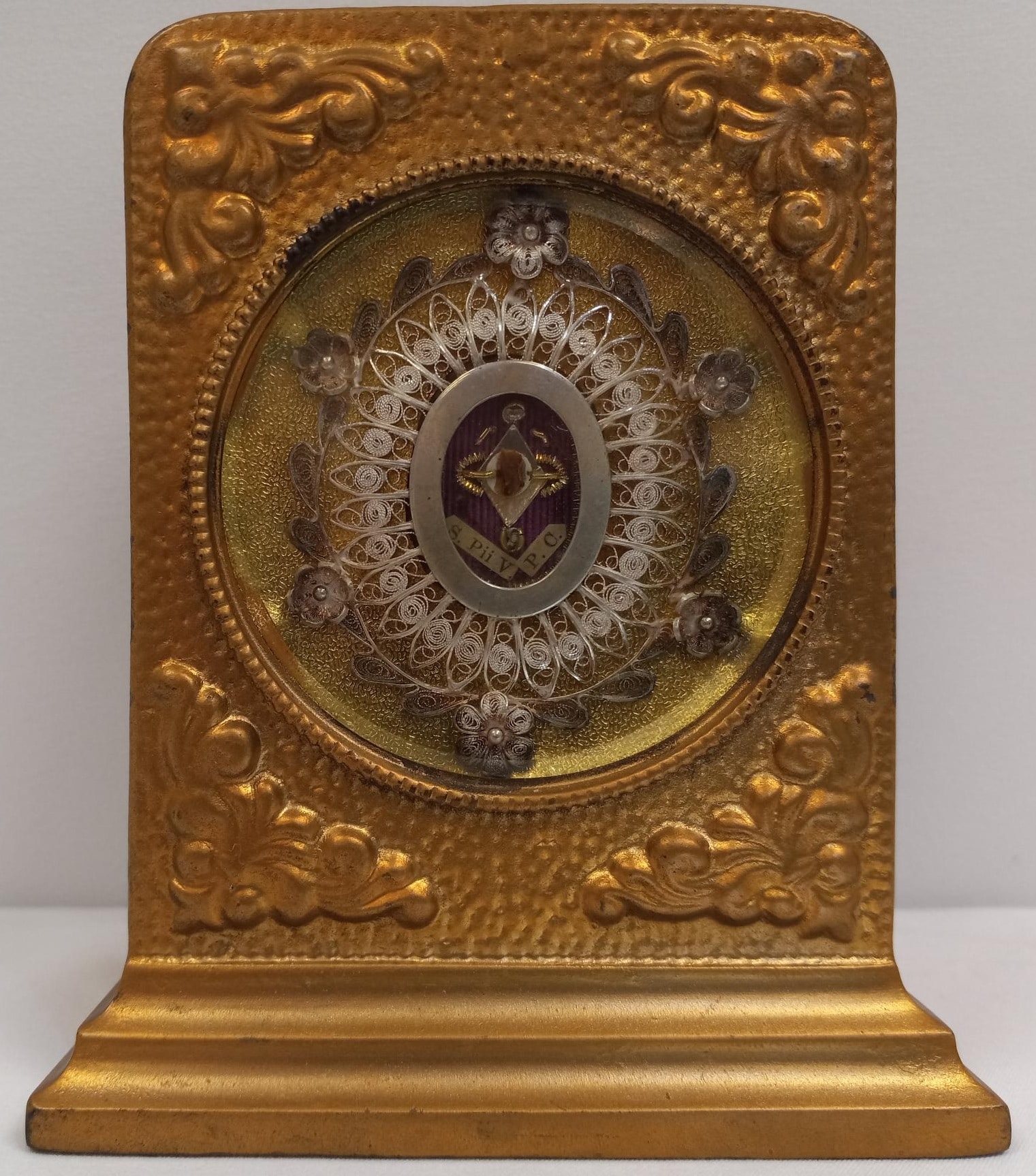
The St. Pius V relic and reliquary, made from a former alarm clock. COURTESY OF ARCHIVES
The unusual origin of this mysterious reliquary
BY EDWARD WILSON, ARCHIVES
In the November 2020 issue of the WKC, the archives featured a relic of St. Veneranda as “The most remarkable relic in the Diocese of Owensboro’s Archives.” Being that we have another relic that is, likewise, noteworthy in appearance, another November relic article does not seem uncalled for.
Unlike the relic of St. Veneranda, a relatively unknown martyr of the early Church, this relic is of one of our most renowned popes, St. Pius V. A list of his deeds and character is far too vast for this article but, most focally, he was crucial in repelling the advances of the Ottoman Empire as well as in quelling the spread of the Protestant Reformation. However, what makes this relic so visibly striking and peculiar is not the relic, itself, but the reliquary that contains it.
The most common reliquaries are small metal containers, about 1” in diameter, with one open side covered by glass, to expose the contained relic. When these are venerated, they are often placed in a standing reliquary that resembles a small monstrance. Outside of these, reliquaries can vary drastically: from arms of precious metal containing full radius and ulna bones, to gilded busts containing skulls, to glass coffins containing brilliantly bejeweled corpses. These reliquaries are handmade, artisanal works crafted with grandeur in mind. This reliquary may appear to be one of these handmade pieces, crafted specifically for the relic, but further inspection proves otherwise.
The reliquary is 4 ½” tall and 3 ½” wide. At about 2 pounds, it is noticeably heavy in the hand. The face of its gold-gilded metal framework is garnished with four filigree embellishments that resemble over-bloomed fluers-de-lis. A raised edging cradles the glass that encases the reliquary’s ornamented interior. Atop the brilliant gold backdrop, wire-work reminiscent of Romanesque ornamentation encompasses the relic. This is surrounded by yet more wirework, stretching like vines betwixt six, small wire-formed flowers – four partially bloomed – with the ones at top and bottom in full bloom.
What makes this beautiful piece of craftsmanship so peculiar? Well, it was never intended to be a reliquary. Upon further inspection, the back reveals eight plugged, non-uniform holes. A closer examination and some imagination reveal the object’s initial purpose; it was a clock. The make and model are absent but the paten date of 1902 is slightly legible. Additional research revealed that the body is of a 1902 Westclox alarm clock.
Though we cannot be sure, it is likely that the relic obtained this posh vessel sometime after it arrived in America, not while it was in Italy. For one, Westclox is an American company. Further, upon unscrewing the back, in search of provenance, it was revealed that the holes in the back were hidden by a piece of a gold painted greeting card of American origin.
Though this reliquary appears to be of much nobler European origins, it is simply American ingenuity. The life of this object should clearly illustrate that honors unimaginable can come to even the lowliest. This humble little clock is now the guardian, resting place and adoration vessel for one of our most revered popes, now gloriously residing in heaven.
Edward Wilson is the director of the Diocese of Owensboro’s Archives and the Archives of the Ursuline Sisters of Mount Saint Joseph. Comments and questions may be sent to [email protected].
Originally printed in the November 2021 issue of The Western Kentucky Catholic.