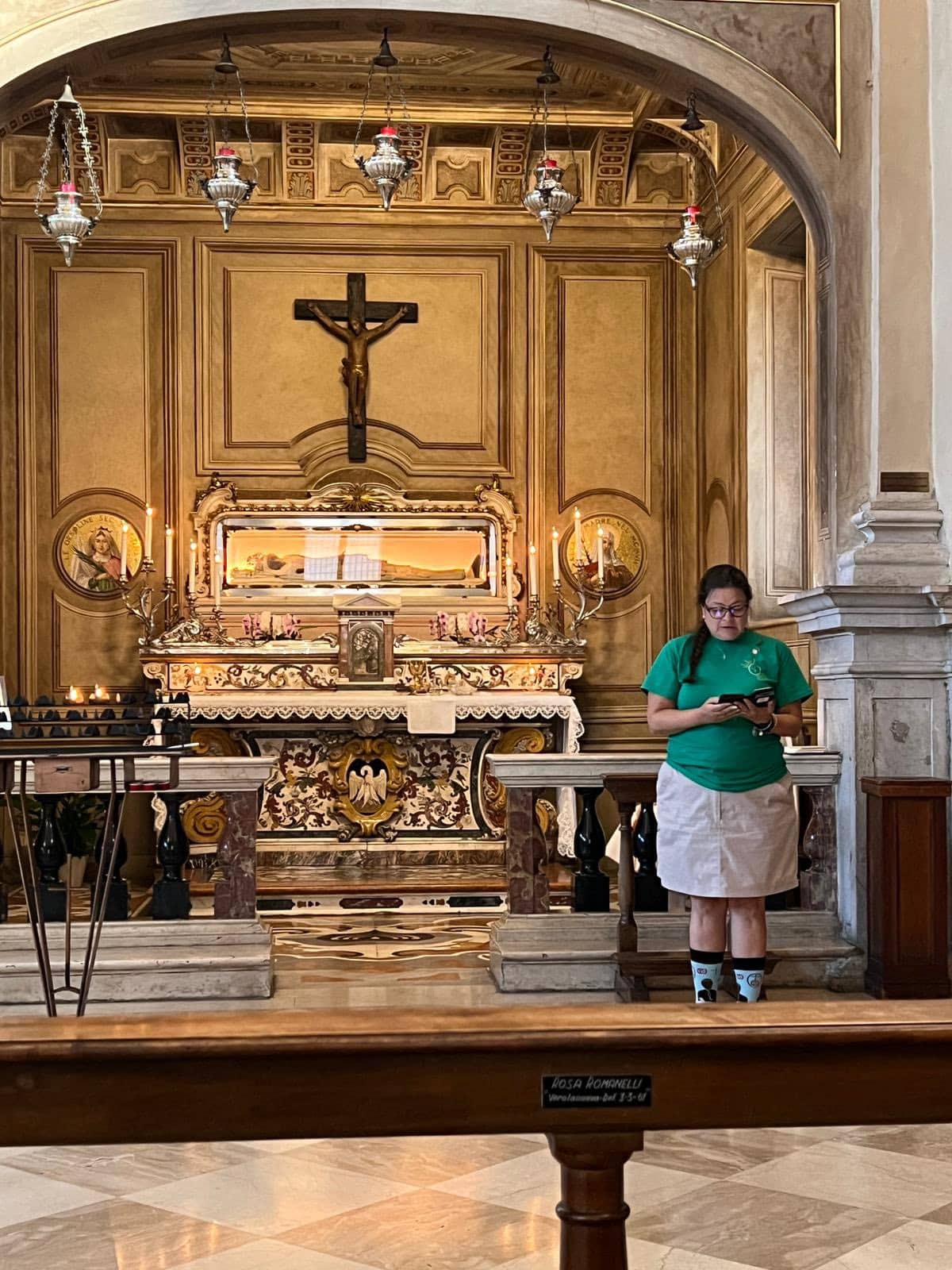
Susan Montalvo-Gesser, director of Catholic Charities of the Diocese of Owensboro, serves as a lector during Mass held at the tomb of St. Angela Merici in Brescia, Italy, during a September 2025 pilgrimage. COURTESY OF SUSAN MONTALVO-GESSER
Unintentionally traveling light
A pilgrim’s journey through Italy and the lessons of Mark 6:7-9
BY SUSAN MONTALVO-GESSER, SPECIAL TO THE WESTERN KENTUCKY CATHOLIC
The Christian tradition of pilgrimage is often defined by a profound paradox. It is a quest for spiritual enrichment accomplished by leaving behind the comforts of home. My own pilgrimage to Italy, a land steeped in centuries of faith, provided a powerful, personal context for understanding this ancient practice.
My pilgrimage started with an unexpected turn: before leaving the U.S., my car was stolen and my luggage, full of prayer intentions from the Diocese of Owensboro’s Disciples Response Fund (DRF), and all my important “stuff,” was gone.
For about a half-hour, less than 24 hours before my flight, I felt panicked and upset. But then my daughter, Josephine, called and reminded me of Jesus sending the disciples out with instructions not to bring a lot of stuff (see Mark 6:7-9).
As I digested her advice, I remembered a homily Fr. Larry Hostetter had given on detachment and I knew this was the time to be detached. I could pray for the DRF intentions without the cards physically with me. In traveling through Rome, Assisi, Desenzano, Brescia, and other sacred sites, I was reminded of Jesus’ instructions to his disciples in Mark 6:7-9 and the lives of Sts. Francis, Clare and Angela Merici in their call for radical trust and simplicity. The experience illuminated the profound truth that a pilgrim is more than a tourist: a pilgrim is a seeker of grace, whose journey is not about what they bring, but of what they are willing to let go.
Mark’s Gospel describes Jesus sending out the apostles, commanding them to “take nothing for their journey except a staff – no bread, no bag, no money in their belts.” The disciples were to cast off worldly dependencies and place their full faith in God to provide for their needs through others. This directive was radical then, and it remains a counter-cultural today, particularly in an age defined by consumption and self-reliance. My journey still revealed this truth.
As I navigated Rome, a city built on sacred ruins and bustling with modern life, the juxtaposition of ancient faith and contemporary noise was striking. The command to “take nothing” was not about a literal lack of provisions but about a posture of spiritual receptivity. In the vastness of the Vatican, I found that shedding my expectations allowed me to be fully present. I stood in awe and prayer before the Pieta, prayed the Angelus with Pope Leo XIV, and lovingly touched the Angels Unawares statue.
Assisi offered a different lesson, reflecting the spirit of St. Francis, who embodied the very poverty and simplicity Jesus called for. Franciscans, like the apostles of Mark 6, chose a life of dependence, trusting entirely in God’s provision. As we moved north toward the birthplace of St. Angela Merici, and Brescia where she founded the Company of St. Ursula, I could feel both anxiety about leaving that “mountaintop” experience, and the hope of seeing the sites that inspired St. Angela.
And hope does not disappoint: St. Angela’s hope led her, in her old age, to start and order to plant seeds of education for a more peaceful future. Seeing the little room from which she did this in Brescia was powerful in its simplicity. We had Mass in St. Angela’s chapel. I cried some grateful tears.
I had been depending on this pilgrimage to fill my cup, drained by the negatives, the needs around me, and my spiritual poverty; but our cups are never empty on the journey as long as we have others loving and accompanying us. Like the disciples, we must depend on others. The call to simplicity in Mark 6 was a reminder that the disciples’ authority came not from their gear but from their commission by Jesus.
It is the same with us.
Susan Montalvo-Gesser is the director of Catholic Charities of the Diocese of Owensboro.
Originally printed in the November 2025 issue of The Western Kentucky Catholic.