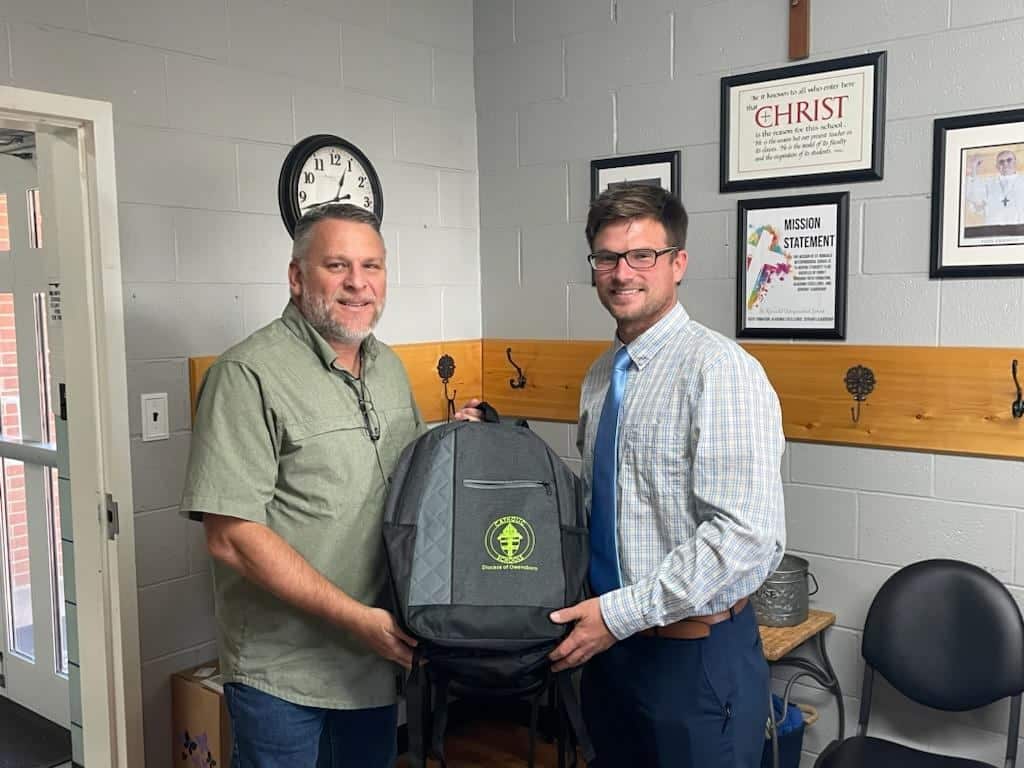
Scott Ingram delivers classroom safety backpacks to Clint Board, principal of St. Romuald Interparochial School in Hardinsburg, on Oct. 21, 2024. Ingram, the Diocese of Owensboro’s director of disaster prevention, preparedness, and emergency operations, received a grant from the Catholic Foundation of Western Kentucky, which is funded by the annual Disciples Response Fund, to distribute enough backpacks for every classroom of the diocese’s 17 schools. COURTESY OF SCOTT INGRAM
Safety first: Catholic schools increase preparedness and prevention
BY ELIZABETH WONG BARNSTEAD, THE WESTERN KENTUCKY CATHOLIC
Catholic Schools Office superintendent David Kessler’s philosophy when it comes to school security is that “I come to work here; I come to school here; I should feel safe when I’m here.”
Every school year, Kessler, who oversees all 17 schools within the Diocese of Owensboro, reminds school councils to include a focus on safety operations and procedures.
“Just so it’s continually something you talk about as a group,” he said. “It is good for people to understand why you do the things you do (for safety purposes).”
Kessler has been working with Scott Ingram – diocesan director of disaster prevention, preparedness, and emergency operations – to perform risk assessments for the diocese’s schools. The assessments include studying data on locations where behavioral incidents are more likely to take place during the school day.
“That’s where Scott’s background in law enforcement is helpful, to see from someone else’s perspective, who is in your corner, to help you evaluate the needs of your school,” said Kessler.
Ingram retired in 2016 from his position as a detective with the Daviess County Sheriff’s Department, where he was assigned to the State of Kentucky’s Cabinet of Health and Family Services to perform specialized investigations, receiving multiple awards and honors for his service.
If school assessments can identify “problem areas,” said Kessler, they then discuss “how could we improve (school) procedures” to decrease the likelihood of these situations developing.
One tangible step is Ingram providing safety and disaster training for school faculty and staff.
While no procedure is perfect, “it helps the schools feel more confident in case something happens,” said Kessler.
Ingram said the goal is to take “some of that stress off” the schools when it comes to safety.
He emphasized that disaster preparedness does not just refer to physical violence: “With the tornado activity we’ve had in this region, we want the teachers to pe prepared with whatever they need to do in any situation.”
A tangible step is providing every classroom in the diocese – through a grant from the Catholic Foundation of Western Kentucky, which is funded by the annual Disciples Response Fund – with a backpack filled with basic safety necessities.
In addition to first-aid items like an emergency blanket and a tourniquet, all backpacks bear a reflective “Diocese of Owensboro Catholic Schools Office” logo to quickly identify the person carrying it in the event of a crisis.
Ingram is encouraging the schools to include the backpacks in the schools’ routine health and safety trainings but said that they are welcome to personalize them according to the classrooms’ unique needs.
“I explained at our principals meeting to show how they work,” said Kessler. “We’re giving them the basics – and they can decide what works for them.”
By press day for this issue of the WKC, Ingram will have delivered all 412 backpacks to the 17 schools.
Kessler said that this falls in line with his ongoing initiative to foster greater equity across the schools, no matter their size or location.
“Every classroom will have the essentials,” he said. “It’s like having an AED machine, you hope you never have to use it, but you want it available.”
Originally printed in the November 2024 issue of The Western Kentucky Catholic.